

A practical guide to choosing your weekly schedule for strength, muscle growth and manageable recovery.
For most adults, at least two strength-training sessions per week is a reasonable starting point; beginners generally do well with two or three [1] [2] [3]. That is a useful default, not a proven optimum for everyone. Muscle growth usually depends more on weekly training volume than on how many days you spread it across [4] [5] [6]. Strength findings are more mixed: extra sessions sometimes help, but more gym visits do not automatically mean better results [7] [8] [9].
First, count sessions and muscle exposures separately
When someone says they train four times a week, you still need to know what happens on those days. Session frequency means total workouts. Muscle-group frequency means how often a particular muscle group is trained. Those numbers can be quite different.
For illustration, imagine two full-body workouts on Monday and Thursday, each covering the same muscle groups. Each group gets two weekly exposures. Now imagine upper-body workouts on Monday and Thursday and lower-body workouts on Tuesday and Friday. That is four gym visits, but still two exposures for each group covered by that split.
These examples explain the counting; neither is an optimal tested prescription. They also say nothing about how much work happens in each workout. Two people can train a muscle equally often while doing very different amounts of training.
So, when comparing schedules, ask both questions: how many days will I train, and how often will each muscle group be trained? Research comparing split and full-body routines supports looking beyond the routine’s label to the work it actually contains.
Understand what “the same weekly volume” means
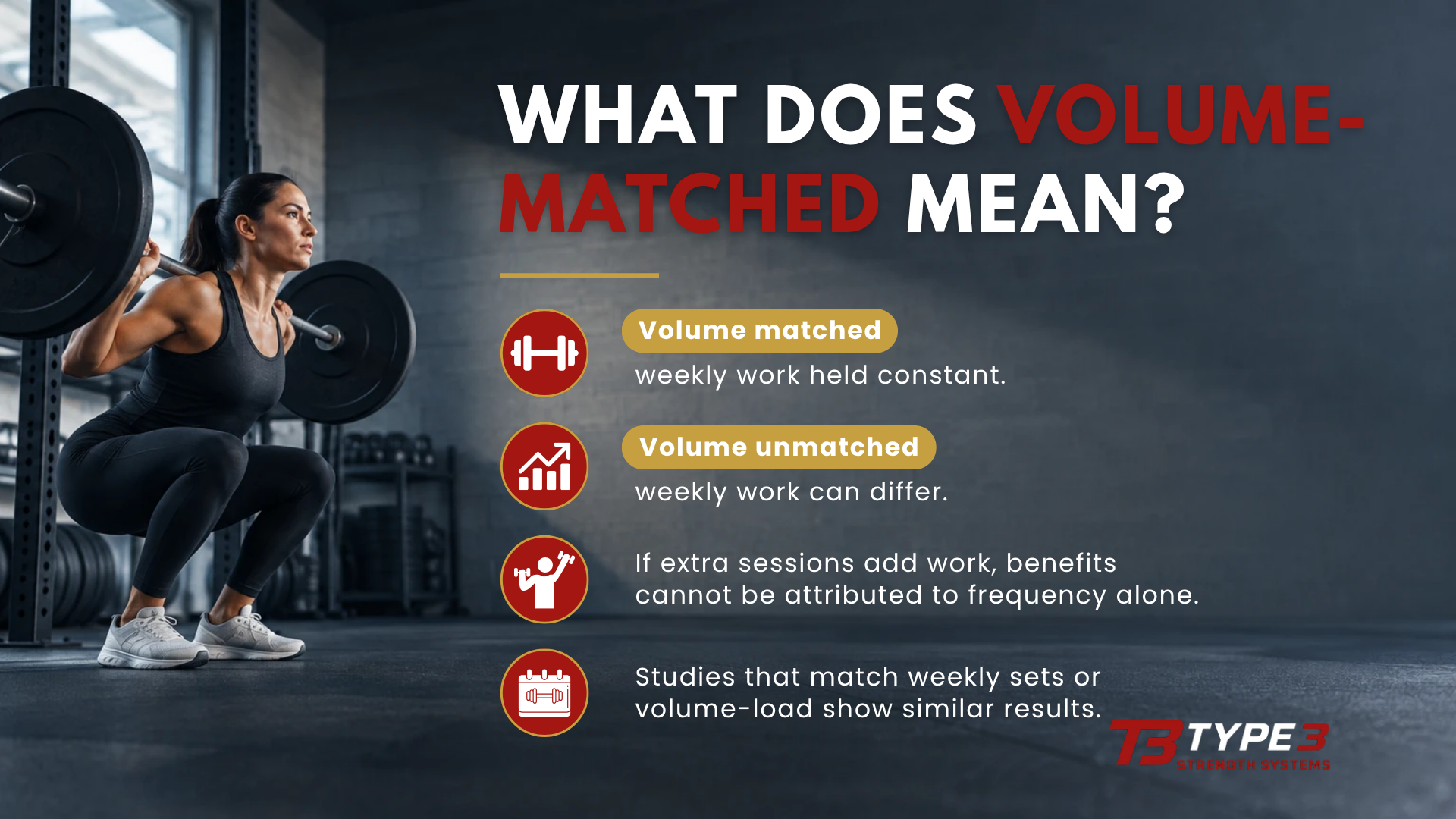
Weekly volume is the amount of training accumulated across the week. In a volume-matched comparison, researchers try to hold that amount constant while changing its distribution. A higher-frequency group does more frequent sessions, not necessarily more total training. In an unmatched comparison, the schedules can differ in both frequency and weekly workload.
That distinction changes the question. If extra sessions also add work, a better result cannot be attributed to frequency alone. More days may be useful because they make additional work possible, rather than because another training day has a special effect.
There is another wrinkle: studies do not all match volume the same way. Some equate prescribed weekly sets; others use volume-load, calculated from sets, repetitions and load. Equal prescribed sets do not necessarily mean equal completed volume-load or effort. A group that tolerates heavier loads or less fatigue may complete more work despite an identical set target.
Keep that qualification in mind when reading “volume matched.” It is an important design feature, not a guarantee that everything except frequency was identical.
Sources: [7], [5], [12], [13], [14]
For muscle growth, frequency is mainly a way to organize work
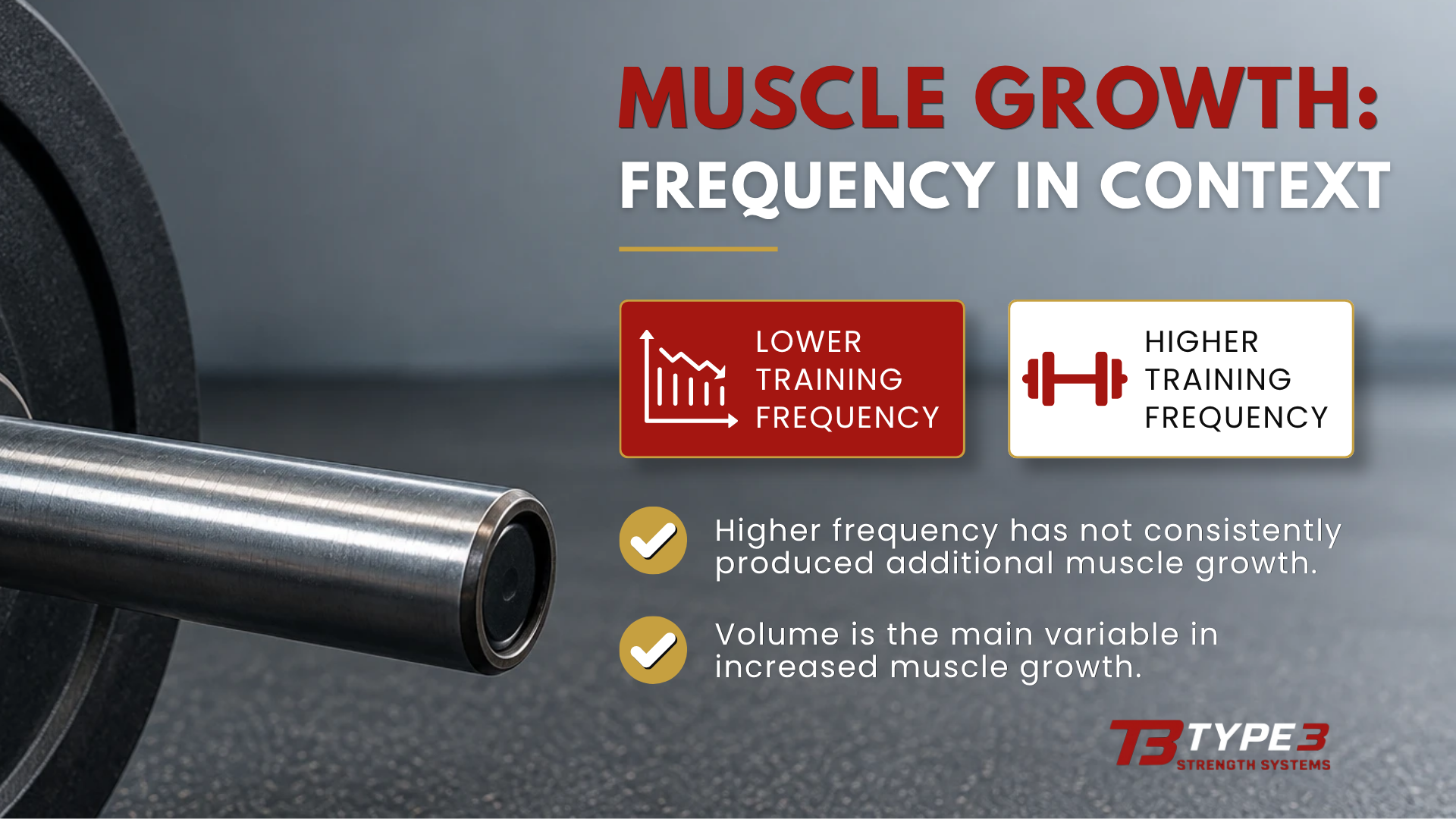
If your main goal is building muscle, the broad evidence gives you considerable scheduling flexibility. Meta-analyses and reviews generally find similar muscle growth across frequencies when weekly volume is equated. Split-versus-full-body comparisons point in the same direction when weekly work is comparable.
That does not mean every schedule is identical, or that frequency can never matter. It means higher frequency has not consistently produced additional growth on its own in these comparisons. When volume is not matched, higher-frequency programs can look better, with the extra weekly work an important explanation.
The practical implication is straightforward: you do not need to add training days solely because a busier calendar looks more serious. An extra day can still be useful if it makes your intended workload more manageable. Conversely, fewer visits can be reasonable if they accommodate that work and your recovery.
The decision is less about finding a magic number of muscle exposures and more about finding a workable home for your weekly training.
For strength, extra exposures sometimes offer more
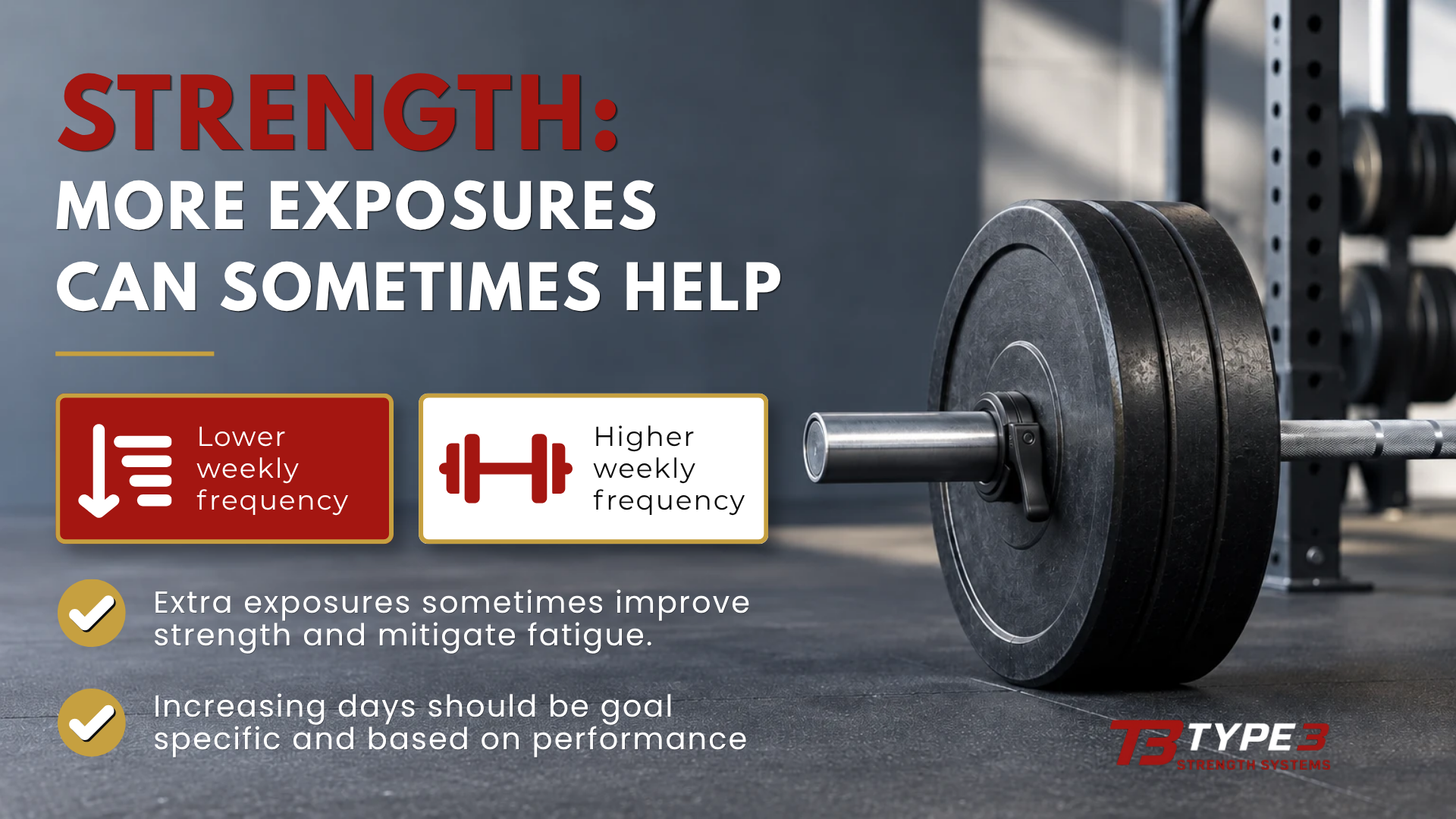
Strength deserves a separate answer. Earlier meta-analyses found no clear independent frequency benefit once weekly volume was equated. More recent dose-response and multi-study analyses suggest small benefits from higher frequency, with diminishing returns. The evidence therefore does not support either “frequency never matters” or “more is always better.”
Some controlled trials illustrate the exceptions. In untrained men performing knee extensions, three weekly sessions produced greater gains in maximal voluntary contraction strength than one under matched weekly volume, alongside lower perceived session effort. In trained adults, four short lower-body sessions produced greater squat one-repetition-maximum gains than one long session under equalized volume, without a hypertrophy difference. Another trial in recreationally trained men favored four over two weekly sessions for upper-body strength under volume-load matching.
These findings support considering more frequent exposures when strength is the priority. More opportunities to practise a lift or less fatigue within a session are possible explanations, not guarantees.
They also do not overturn the many trials finding similar results. A benefit in a particular lift and population is a reason to consider that approach—not a universal instruction to train four days.
Sources: [7], [8], [16], [17], [18], [19]
Match the starting point to your experience
For beginners, two or three weekly sessions is a defensible starting point. The supplied ACSM-style recommendations, reviews and related evidence support that range for improving strength and muscle size while distributing training across the week [1] [2] [3]. You do not need an experienced lifter’s calendar to begin making progress.
If only one weekly session is realistic, it can still be worthwhile. Minimalist-training evidence and studies in untrained adults show that once-weekly training can improve strength and function, particularly early on. That makes it a viable lower-frequency option, not evidence that it maximizes progress.
Experienced lifters have more flexibility than a simple “advanced means more days” rule suggests. Many controlled comparisons in trained men report similar strength and growth across different frequencies under equated weekly volume. A meta-analysis in well-trained populations found no clear differences in maximal strength development over six to twelve weeks.
Those findings support distributing work according to practical needs, including shorter, more frequent sessions. But a statistically nonsignificant difference does not establish equivalence: these studies cannot prove that all schedules produce identical outcomes, especially over longer periods.
Sources: [1], [2], [3], [20], [21], [22], [23], [9]
Choose a schedule you can complete and recover from
Recovery is not determined by the calendar alone. A review of recovery and training organization identifies higher session volume, lower-body multi-joint lifts, emphasis on the lowering phase and training to failure as factors that can increase recovery demands. Two programs with the same weekly frequency can therefore feel very different.
Start with the days you can realistically protect. Then consider whether your planned work fits those sessions without making them difficult to complete or recover from. If fewer, longer workouts are becoming unwieldy, spreading the existing work across another day is an option. That is different from automatically adding more training.
If extra visits are the problem, a more compact schedule may be more workable. Time constraints are an important barrier to participation, and lower-frequency approaches can still be effective. There is no need to assume that the schedule with the most visits is the most sustainable.
Finally, give any extra day a job. Is it helping you fit the workload, making sessions more manageable, or providing another opportunity to practice a priority lift? Those are evidence-informed reasons to adjust frequency.
Sources: [24], [18], [25], [26], [27], [3]
Key takeaways
- Start with two weekly sessions if possible; two or three is a reasonable beginner range, while one can still help [1] [2] [3] [20].
- Count weekly exposures per muscle group, not just total gym visits [7] [10] [11].
- For muscle growth, organize your weekly workload around a manageable schedule rather than chasing frequency alone [4] [5] [6] [15].
- For strength, consider extra exposures when they serve a clear purpose; the benefits are goal-specific [7] [8] [18] [17] [19].
Need help finding a training schedule that fits your life?
Your goals, experience and available time should shape your plan. Type 3 Strength Systems can help you put those pieces together.
Limitations
- Many trials are small, short and concentrated in young men, often testing only one to three weekly exposures per muscle. Findings are less secure for women, older adults and long-term training [7] [22] [9] [28] [16].
- Volume-matching methods vary, limiting how confidently differences can be attributed to frequency alone [12] [13] [14].
- Long-term randomized comparisons of schedule adherence are scarce, so short-term training results do not establish which routine people will sustain [26] [29] [30] [31].
References
- Ratamess N, Alvar B, Evetoch FTK, et al. American College of Sports Medicine position stand. Progression models in resistance training for healthy adults.. Medicine and science in sports and exercise. 2011;41 3:687-708. doi:10.1249/mss.0b013e3181915670 View source
- Ralston GW, Kilgore LJ, Wyatt F, Buchan DS, Baker J. Weekly Training Frequency Effects on Strength Gain: A Meta-Analysis. Sports Medicine – Open. 2018;4. doi:10.1186/s40798-018-0149-9 View source
- Behm D, Granacher U, Warneke K, Aragão-Santos JC, Da Silva-Grigoletto MD, Konrad A. Minimalist Training: Is Lower Dosage or Intensity Resistance Training Effective to Improve Physical Fitness? A Narrative Review. Sports Medicine (Auckland, N.z.). 2023;54:289 – 302. doi:10.1007/s40279-023-01949-3 View source
- Schoenfeld B, Grgic J, Krieger J. How many times per week should a muscle be trained to maximize muscle hypertrophy? A systematic review and meta-analysis of studies examining the effects of resistance training frequency. Journal of Sports Sciences. 2019;37:1286 – 1295. doi:10.1080/02640414.2018.1555906 View source
- Mcleod JC, Currier B, Lowisz C, Phillips SM. The influence of resistance exercise training prescription variables on skeletal muscle mass, strength, and physical function in healthy adults: An umbrella review. Journal of Sport and Health Science. 2023;13:47 – 60. doi:10.1016/j.jshs.2023.06.005 View source
- Bernárdez-Vázquez R, Raya-González J, Castillo D, Beato M. Resistance Training Variables for Optimization of Muscle Hypertrophy: An Umbrella Review. Frontiers in Sports and Active Living. 2022;4. doi:10.3389/fspor.2022.949021 View source
- Grgic J, Schoenfeld B, Davies T, Lazinica B, Krieger J, Pedišić Ž. Effect of Resistance Training Frequency on Gains in Muscular Strength: A Systematic Review and Meta-Analysis. Sports Medicine. 2018;48:1207-1220. doi:10.1007/s40279-018-0872-x View source
- Pelland JC, Remmert JF, Robinson ZP, Hinson SR, Zourdos MC. The Resistance Training Dose Response: Meta-Regressions Exploring the Effects of Weekly Volume and Frequency on Muscle Hypertrophy and Strength Gains.. Sports medicine. 2025. doi:10.1007/s40279-025-02344-w View source
- Cuthbert M, Haff G, Arent S, et al. Effects of Variations in Resistance Training Frequency on Strength Development in Well-Trained Populations and Implications for In-Season Athlete Training: A Systematic Review and Meta-analysis. Sports Medicine (Auckland, N.z.). 2021;51:1967 – 1982. doi:10.1007/s40279-021-01460-7 View source
- Evangelista A, Braz TV, La Scala Teixeira CV, et al. Split or full-body workout routine: which is best to increase muscle strength and hypertrophy?. Einstein. 2021;19. doi:10.31744/einstein_journal/2021ao5781 View source
- Ramos-Campo D, Benito-Peinado PJ, Andreu-Caravaca L, Rojo-Tirado MA, Rubio-Arias JÁ. Efficacy of Split Versus Full-Body Resistance Training on Strength and Muscle Growth: A Systematic Review With Meta-Analysis. Journal of Strength and Conditioning Research. 2024;38:1330 – 1340. doi:10.1519/jsc.0000000000004774 View source
- Neves RP, Vechin F, Teixeira E, et al. Effect of different training frequencies on maximal strength performance and muscle hypertrophy in trained individuals—a within-subject design. PLoS ONE. 2022;17. doi:10.1371/journal.pone.0276154 View source
- Damas F, Barcelos C, Nóbrega SR, et al. Individual Muscle Hypertrophy and Strength Responses to High vs. Low Resistance Training Frequencies. Journal of Strength and Conditioning Research. 2019;33:897–901. doi:10.1519/jsc.0000000000002864 View source
- Barcelos C, Damas F, Nóbrega SR, Ugrinowitsch C, Lixandrão M, Libardi C. High-frequency resistance training does not promote greater muscular adaptations compared to low frequencies in young untrained men. European Journal of Sport Science. 2018;18:1077 – 1082. doi:10.1080/17461391.2018.1476590 View source
- Grgic J, Schoenfeld B, Latella C. Resistance training frequency and skeletal muscle hypertrophy: A review of available evidence.. Journal of science and medicine in sport. 2019;22 3:361-370. doi:10.1016/j.jsams.2018.09.223 View source
- Tao M, Yin M, Zhong Y, et al. Impact of resistance training frequency on physiological and performance adaptations: A systematic review and meta-analysis. International Journal of Sports Science & Coaching. 2026;21:2628 – 2648. doi:10.1177/17479541261428779 View source
- Ochi E, Maruo M, Tsuchiya Y, Ishii N, Miura K, Sasaki K. Higher Training Frequency Is Important for Gaining Muscular Strength Under Volume-Matched Training. Frontiers in Physiology. 2018;9. doi:10.3389/fphys.2018.00744 View source
- Pedersen H, Iversen VM, Vereide PF, et al. High‐frequency resistance training improves maximal lower‐limb strength more than low frequency. European Journal of Sport Science. 2024;24:557 – 565. doi:10.1002/ejsc.12055 View source
- Arazi H, Asadi A, Gentil P, et al. Effects of different resistance training frequencies on body composition and muscular performance adaptations in men. PeerJ. 2021;9. doi:10.7717/peerj.10537 View source
- Pearson L, Fox KT, Keenan A, et al. Comparison of low-dose maximal-intent versus controlled-tempo resistance training on quality-of-life, functional capacity, and strength in untrained healthy adults: a comparative effectiveness study. BMC Sports Science, Medicine and Rehabilitation. 2024;16. doi:10.1186/s13102-024-00847-z View source
- Lasevicius T, Schoenfeld B, Grgic J, Laurentino G, Tavares L, Tricoli V. Similar Muscular Adaptations in Resistance Training Performed Two Versus Three Days Per Week. Journal of Human Kinetics. 2019;68:135 – 143. doi:10.2478/hukin-2019-0062 View source
- Hamarsland H, Rønnestad B. Equal-Volume Strength Training With Different Training Frequencies Induces Similar Muscle Hypertrophy and Strength Improvement in Trained Participants. Frontiers in Physiology. 2022;12. doi:10.3389/fphys.2021.789403 View source
- Saric J, Lisica D, Orlić I, et al. Resistance Training Frequencies of 3 and 6 Times Per Week Produce Similar Muscular Adaptations in Resistance-Trained Men.. Journal of Strength and Conditioning Research. 2019. doi:10.1519/jsc.0000000000002909 View source
- Sousa CA, Zourdos MC, Storey A, Helms ER. The Importance of Recovery in Resistance Training Microcycle Construction. Journal of Human Kinetics. 2024;91:205 – 223. doi:10.5114/jhk/186659 View source
- Johnsen E, Van Den Tillaar R. Effects of training frequency on muscular strength for trained men under volume matched conditions. PeerJ. 2021;9. doi:10.7717/peerj.10781 View source
- Collins KA, Huffman K, Wolever RQ, et al. Determinants of Dropout from and Variation in Adherence to an Exercise Intervention: The STRRIDE Randomized Trials. Translational journal of the American College of Sports Medicine. 2022;7. doi:10.1249/tjx.0000000000000190 View source
- Currier B, Mcleod JC, Banfield L, et al. Resistance training prescription for muscle strength and hypertrophy in healthy adults: a systematic review and Bayesian network meta-analysis. British Journal of Sports Medicine. 2023;57:1211 – 1220. doi:10.1136/bjsports-2023-106807 View source
- Kneffel Z, Murlasits Z, Reed J, Krieger J. A meta-regression of the effects of resistance training frequency on muscular strength and hypertrophy in adults over 60 years of age. Journal of Sports Sciences. 2020;39:351 – 358. doi:10.1080/02640414.2020.1822595 View source
- Santos KDD, Sá A, Santos LGD, et al. What works to improve resistance training adherence? A systematic review of intervention strategies. Malque Health. 2025. doi:10.31893/health.2026004 View source
- Conti F, Marzagão T, Galpin AJ, Schoenfeld BJ. Predictors of long-term resistance exercise adherence: evidence from a large cohort of mobile app users of various experience levels. Frontiers in Sports and Active Living. 2026;8. doi:10.3389/fspor.2026.1855668 View source
- Kekäläinen T, Kokko K, Tammelin T, Sipilä S, Walker S. Motivational characteristics and resistance training in older adults: A randomized controlled trial and 1‐year follow‐up. Scandinavian Journal of Medicine & Science in Sports. 2018;28:2416 – 2426. doi:10.1111/sms.13236 View source